This Story Will Make You Mad.

When you have chronic lyme disease, it can be very hard to know who or what to trust. This story is a perfect example.

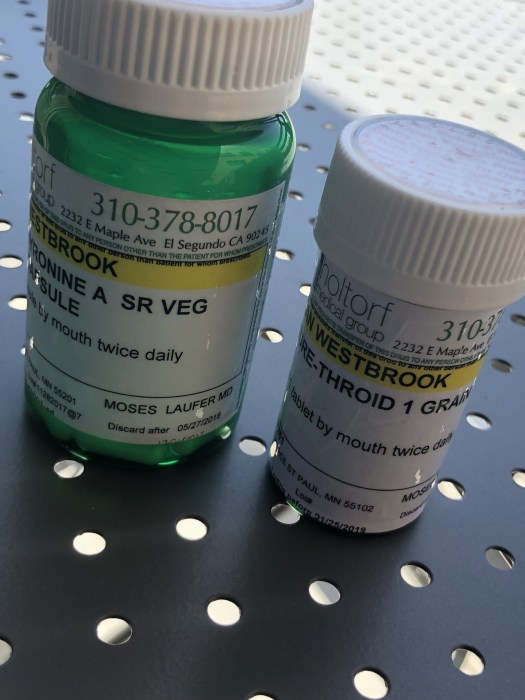
When I was diagnosed with chronic lyme disease in 2013, I was also diagnosed with hypothyroidism, as I had low T3, which is a hormone produced by the thyroid gland. I had an unusual situation, as I had low T3, but normal TSH (Thyroid Stimulating Hormone). Normally, if you have low T3, you also have high TSH. But I didn’t.

Apparently, this was cause for concern, as one situation that produces low T3 and normal TSH is a brain tumor. So, my lyme doctor ordered an MRI of my brain. You can bet I was super relaxed about that. Thankfully, I did not have a brain tumor. Thus, my doctor said the lyme infection in my brain (it breaks through the blood brain barrier in the first 48 hours) was interrupting the communication between my hypothalamus and my pituitary gland. The two need to be on good speaking terms in order for the thyroid to function properly.

My lyme doctor recommended thyroid hormones. This turned into a major discussion, because a functional medicine doctor I was seeing at the time implored me not to take the thyroid hormone. He basically said it would goof everything up and that there were more natural ways of dealing with my thyroid issues.

At the time I was dealing with severe fatigue. As in, we were on a previously planned trip to Disney and I had to use a mobility scooter because there was no way I could have walked the park. That kind of fatigue. Can you imagine?

I didn’t know who to believe about the thyroid medication, but I knew something needed to change in the way I felt, so against my better judgement, I decided to take the thyroid hormone.

I have seen two different lyme doctors since the one who originally prescribed the thyroid hormone, and they both recommended I stay on it. Over the years, my T3 levels were closely monitored, with blood draws very six to eight weeks, followed by medication adjustments, if necessary.

Fast forward to fall of 2017. Suddenly, I’m having all sorts of issues with regulating my body temperature. I have a history of always being cold, but suddenly I was always hot. Like, really hot. I spent the harsh Minnesota winter in a sweat. Sometimes I’d walk around the house half naked. I’d be in a public space, and I’d note I was wearing a t-shirt while everybody else was bundled up in sweaters and jackets. 

I know what you are thinking. Menopause. While I am of a certain age, I’m still menstruating, so that wasn’t the issue. 

When you are being treated for chronic lyme disease, you tend to move away from traditional western medicine practitioners, because they look at you like you are crazy when you say you have lyme disease. It gets old.

But the body temperature thing was really bugging me, and I had a hunch it had something to do with my thyroid. So, I made an appointment with an endocrinologist. 

After starting the meeting with the standard “I know you don’t recognize this, but I have chronic lyme disease” conversation, I told the doctor about my past thyroid issues, along with my current symptoms and medications.

He asked to see my blood work from before I started the thyroid hormones, which I had on hand. Sadly, I’m a pro at this, and anticipated his request.  He then asked the million dollar question. He said “How much did you weigh when this blood work was done?” I told him I didn’t know for sure, as it was many years ago, but I guessed it was south of a hundred pounds.

To which he said “I don’t think you were hypothyroid. I think you were starving. When your weight gets too low, things don’t work right.”

When he said that, tears literally popped out of my eyes and rolled down my face. I didn’t even care. I was completely unselfconscious about it. Why was I crying? First, I never wanted to take those damn thyroid hormones in the first place, and it turned out I never needed to. So, that pissed me off. Second, it just reinforced how difficult it is to navigate the lyme jungle. I had not one, but three lyme doctors tell me I had lyme related hypothyroidism, and that it was critical for me to take the medication. In that moment, I was just so exhausted on navigating conflicting medical opinions.

The lyme doctors didn’t make any money off the medication, so I can only believe they had the best of intentions, but still. It’s just infuriating. There are many risks associated with taking thyroid hormones, and it turns out I unnecessarily exposed myself to those risks for four years. Not to mention, taking thyroid hormones is a huge pain in the butt. You have to take them first thing in the morning, one hour before any food, drink or other medication. Psychologically, it never made me feel good to roll out of bed and pop a pill first thing. It just sends the wrong message. I’m sick. I need medication to function. I hated starting my day that way, and I’m getting mad all over again as I write this.

But back to my appointment with the endocrinologist. Once he handed me a tissue and I stopped crying, he suggested I discontinue the thyroid hormones, and then come in for a blood draw in three weeks, once the medication fully cleared my system.

You can already see where this is going. My thyroid labs were completely normal. I was taking medication for no reason. In fairness, I have gained 26 pounds in the last two years, so that likely has something to do with my T3 levels coming back into the normal range.

Two things have happened since I discontinued the thyroid hormone:

  1. Over the course of a few months, my body temperature issues resolved, and I am no longer overheating.
  2. I started to gain weight at an increased clip.

When I noticed my increased weight gain seemed to coincide with discontinuing the hormone medication, I emailed the endocrinologist to ask if there was a correlation. He said there absolutely was. So, all these years, when I have been struggling to gain weight, the thyroid hormones were playing a role in holding me back. My GI system is still totally whacked, so I can’t put all the blame on the thyroid medication, but let’s just say it wasn’t helping anything.

I’m still pretty mad about all this. Yes, it’s true, I did have low T3 at one point. But I’ve learned it’s also true that not all thyroid deficiencies need to be treated, particularly if there is an extenuating circumstance, such as dramatic weight loss.

Here is the moral of the story. You know that expression “to a man with a hammer, everything looks like a nail.” I think that’s also true of many lyme doctors – everything looks like lyme to them. And that’s my advice today – if you have chronic lyme, or chronic anything, be on the lookout. It’s too easy for doctors to just blame everything on your chronic condition.

For whatever reason, I always had a nagging feeling my thyroid issue was not lyme related, but I never acted on my hunch because I had three people who had gone to medical school telling me I needed to be on medication, and I figured they were in a better position to know that than I was. Well, that turned out to be misplaced trust.

I am sad to say that after nearly five years navigating the mess of chronic lyme disease, I truly don’t know who to believe or who to trust. I think the fact of the matter is nobody has chronic lyme completely figured out. Not western medicine doctors, not functional medicine doctors, not lyme literate MDs. Nobody. Everybody has their own theories, and I believe they believe them. And I think most practitioners who treat lyme patients have nothing but good intentions. But I can’t help feeling like a human guinea pig. 

We are still on the frontier of this epidemic, and until it gets more attention from the CDC and Western Medicine, there’s not going to be a standard treatment protocol, which means people are going to continue to struggle to get proper care, and will occasionally get sent down errant rat holes, as I did. 

I realize this is more negative than I tend to be, but lyme disease is a bitch, and people who suffer from it have to work way too hard to get well, as they are simultaneously fighting the disease and the system.

I know things could be much worse, and I need to hang on to that perspective. I have learned so much from being sick, and I would never give those lessons back.  But lyme disease has taken much from me, and I have sadness and anger about that. Buy I will never stop trying to regain what I’ve lost. Never. Ever.

Home From Vacation Saturday. In Bed Most of Sunday.

Here’s something that never ceases to amaze me. When we go on vacation, somehow, I always manage to hang on just long enough so my fatigue doesn’t interfere with the fun. Then when I get home, I collapse. It’s sort of like the car running out of gas just as it coasts into the garage.

It happens every time we go somewhere. The first morning home I will wake up feeling relatively fine, but as the day goes on and I attempt the tasks of re-entry, my brain and body begin to melt down. Slowly at first, and then all at once.

It’s not like I need a nap. It goes significantly deeper than that. My mind and body get so fatigued that I literally can’t think or function. It’s a sensation of being completely overwhelmed by the normal noise and rhythm of life. It’s hard to describe exactly what it feels like, but let’s just say it feels super crappy. I basically want to escape my own body because it’s so unpleasant in there.

Sitting in my resting chair brings no relief. Chilling with a movie is not an option – the stimulation is overwhelming. When it gets this bad, there are really only two remedies: bed and silence.

I have to be in bed with the covers pulled way up. The weight of the bedding somehow shuts out the stimulation and noise of life. It comforts and soothes. Releasing my head to the softness of the pillow allows my brain to relax and rejuvenate.

In these moments, I’m reminded of a hair dryer that overheats. It gets so hot it has to shut down in order to save itself. And there’s only one thing that will get that hair dryer to turn back on. Time.

It’s the same for me. As frustrating as it can be, when my brain and body shut down, the only option is to lay down and wait. It feels awful at first, but the longer I lay in the stillness and silence, the better I feel. After a few hours, I might feel up to reading. And after a few more hours I might feel up to sitting in a chair.  It usually takes most of the day for my fried circuits to cool down and start functioning properly again.

In an ideal world, I would always manage my life and my activities so I never got to this point. But sometimes, I put fun before fatigue management, knowing I will pay a price later. If I avoided everything that makes me tired, I would miss out on a whole lot of laughter, love and general enjoyment of life.

Did I enjoy the way I felt yesterday? Absolutely not.

But I most definitely enjoyed the seven days that preceded yesterday.

My daughter will be off to college soon, meaning family time is more precious than ever, and I am soaking up every last drop before my little nest empties out.

Sometimes, that family time comes at a price for me, but it’s one I’m happy to pay.

Things Are Looking Up.

Last week was a good one. For starters, my raging nerve pain (you can read about it here) responded to my second cortisone shot. The pain is not completely resolved, but it has gone from excruciating to annoying, and I can live with that.

The real big news involves stepping on the scale, which I did last week for the first time in months. I weigh myself only sporadically, so as not to obsess about gaining weight, and to avoid disappointment, as the weight is coming on ever so slowly.

But it’s been a while and I just had a feeling the news would be good. Well, it was beyond anything I could hope for. I weighed a whopping (for me) 105. I stepped off and on the scale four times just to be sure it was real. And then I weighed myself again two days later. Again to be sure. 

Getting this far is incredibly significant for me. If you’ve been reading for a while, you know I weighed 81 pounds a year and a half ago (I’m 5′6″). I don’t have the words to describe the terror involved in weighing so little. I could count every rib. My arm bones were protruding. My abdominal area was concave. My hair was falling out. Now I wish I had a good photo from that time, but it was not a moment I wanted to capture. 

I weighed 118 when I first got sick. And that reflected a recent weight gain due to strength training. So really, I was about 115 before I added muscle. I long ago gave up on ever seeing 118 again, as it was a stretch to get there even when I was healthy. But I told myself if I could just somehow, some way get back to 110 I’d feel pretty good about life. 

Well, I’m within spitting distance of 110. There were so many days when I never thought I’d get this far. For eight years all I did was lose weight in spite of desperate, frantic attempts to do the opposite. It was torture. And terrifying.

But here I am. 105. I don’t have the words to tell you how hard I fought, clawed, and scraped for every single one of the 24 pounds I have gained. It has taken maniacal, ruthless determination and dedication. And I had to give up most solid food. Yes, I’ve been on a primarily liquid diet for the past year and a half. I eat real food once per day, and the rest is a special, pre-digested protein shake called Absorb Plus

And that’s where we come to the mixed blessing of all this. While my weight gain is fantastic, it has happened because of a band aid (liquid diet) and not because anything in my GI tract is actually fixed. Many have tried but none has succeeded in unlocking the mystery of why my GI tract shut down. The Mayo Clinic diagnosed a severe motility disorder of unknown origin, lyme doctors say it’s because of lyme disease.

The Mayo Clinic had no answer except hope and a feeding tube. I said no thanks to that. 

Lyme doctors tell me if I can get rid of the lyme my GI issues will improve. Maybe they are right, but maybe they are not.

I’m in a very vicious cycle. Part of the reason I haven’t been able to kick lyme is because the road out of lyme goes through my GI tract, which cannot tolerate the medications commonly used to treat chronic lyme disease.

If I think about all this too much I become overwhelmed and afraid and it all feels so hopeless. Will I be on a liquid diet forever? Will I ever really solve my GI problems, or will I always be covering them up with band aids?

I don’t have any of those answers. And when I get overwhelmed, I simply bring myself back to the present, and focus on what I can control. I remind myself I’m gaining weight. I remind myself I’m not dealing with stomach pain, nausea and feeling unpleasantly full 24/7. Those are all big, important things, and are not to be overlooked.

I’m meeting with a new GI guy in a couple of weeks. Maybe he will have some new ideas and answers. Or maybe he won’t. Who knows? The only thing I know for sure is that I will never stop trying. 

I have 110 in my sights, and I will not take my foot off the gas until I get there. 

The rest will sort itself out one way or another. 

Pain Versus Suffering.

I have been in near debilitating pain for the last two weeks. This particular situation has nothing to do with lyme disease, and while excruciating, it is much easier to tolerate.

Let me explain.

First, the pain. I fell on the ice a few weeks ago, and ended up herniating a disc in my neck, which led to screaming nerve pain across my left shoulder and down my left arm. I have had nerve pain before, but this is a whole new level. It’s like electricity. 12 out of 10 and I’m not exaggerating. 

Thank goodness, I am comfortable when sitting in a soft chair, and when laying down. However, I can only stand for 5 to 15 minutes before the pain becomes intolerable. I have been literally yowling in pain. The photo above is from a cortisone injection a week ago, which did nothing to ease the pain. I had another one today, and it will be a few days to know if it helps.

While the pain is physically exhausting, it is not wearing me out emotionally. That’s because I can see it as something explainable, it’s easy to understand, and I know it will eventually pass. I’m prepared to gut it out, whether it’s another day, week, or longer.

It’s just pain, and it will pass.

Lyme disease is different.

It’s not easily explainable. It’s hard to understand. And I don’t know if it will ever pass. I would say the same about my GI tract basically shutting down without notice. Ditto for the raging anxiety that somehow became part of my life without my invitation or permission. 

For me, this all amounts to suffering. Please don’t get me wrong. I’m not complaining. Everybody has a cross to bear, and this is mine. It could be worse, and I’m grateful it’s not.

However, I have experienced the darkest of days. The deepest fatigue. The bleakest of thoughts. All courtesy of lyme disease, and there is no easy exit strategy. 

But the nerve situation is so blessedly simple. The doctor pointed to the exact spot on the MRI that is causing my pain. And then he told me the treatment options, which include cortisone injections, surgery and time. I’m not interested in surgery, so I’m going for a cocktail of injections and time at this point.

At times my nerve pain brings me to tears. Other times it steals my breath. But there’s no emotional burden. I’m not wondering if I’m doing enough to help myself. I’m not confused about a myriad of treatment options. I don’t feel stigmatized. It’s all so wonderfully clear. Painful, but clear.

If only lyme disease could be so clear. Then there would be a lot less suffering. 

For me, and for my fellow warriors.

This Was a Moment.

I’m still playing catch up, so this happened back in December.

First, some background. I love Bruce Springsteen. I mean, I really love him, and have for many years. Also, my beloved late brother loved Springsteen, so when I listen to the Boss, I feel my brother, which makes anything Springsteen-related doubly meaningful for me.

Last November, Bruce started a limited engagement on Broadway. It’s a one man show (save two songs with his wife) that cannot be categorized. It’s not a play. It’s not a musical. It’s not a concert per se. It’s an intimate evening with Bruce. Just him, his guitar, his harmonica and his piano in a 900 person seat theater. It’s a mixture of autobiography and song. I read all about the show and desperately wanted to attend, but it was sold out by the time I looked into it.

Now, flash back to a November evening at our home. My husband, daughter and I were casually chatting at the table after dinner. Somehow, the discussion turned to Broadway, which made me think of Bruce, and here is a near verbatim recounting.

Me: I would DIE (major emphasis on that word) to go to that Springsteen show, but it’s sold out.

Long pause.

My husband: No, it’s not.

Me: Yes it is. I checked.

My husband: No, it’s not.

Me: Yes it is. I know for sure.

My husband: Well……. there’s one ticket……. and it’s yours.

Me: (stunned, heart stopping) What?

My husband: You have a ticket.

Me: (still stunned) No. Wait. No. Seriously. No way. No way. NO WAY.

My husband: It’s all set up. I’ve booked your hotel. You’re having dinner with the Dwecks (good friends in NYC) the night before, and then you have the concert the next day. Cecilia already talked to the restaurant to make sure they can accommodate you. Everything is taken care of.

We went through a few more rounds of this before I truly believed it. This is the most thoughtful, wonderful, extravagant surprise of my life. And so well timed.

Before I got sick I had a big, interesting life that involved frequent travel and embracing of new experiences. Then I got sick, and my life slowly shrank into a pinhole. Now, I am on the long road to recovery, and am working to expand my world again.

The complication is I’m not the same person I was before Lyme manhandled my body and mind. Struggle forces you to grow, so I have evolved in many ways that I like and enjoy. But certain things that used to be easy are now hard. Or at the very least, less easy.

I used to travel to New York frequently for work and pleasure. I love the city, know it well, and it’s never been a problem for me to navigate it. But this would be my fist time traveling to the city on my own in my new reality.

Let’s go back to the night my husband told me about the trip. I was incredibly excited. Excited to see Bruce, but also excited for the above. I felt ready for this new challenge, and saw it as an opportunity to re-connect to a part of myself I’ve been missing. I told myself I was going to get on that plane, go to that city, and reclaim a piece of myself.

And that’s exactly what I did.

The trip could not have gone better. I felt capable, competent, strong, brave and independent. All adjectives that have been missing from my life for quite some time. I navigated the city with ease, met my friends downtown for dinner, and I never felt afraid. Was I anxious at times? You bet. But no more so than when I’m sitting at home. So, nothing to worry about there. (Remember, I get anxious every day. It’s just less loud now, and therefore less limiting).

And the concert. I don’t have the words to describe it, so I won’t even try. It was a spiritual experience for me (and for just about everybody there, as far as I could tell). Gripping, emotional, beautiful. The story of a man who spent his life using word and song to wrestle and overcome demons. At times you could hear a pin drop. At times, the roof felt like it would come off. The whole experience was just stunning.

And the best part of all? I took my brother to that concert with me in the form of a button with his photo on it. AND, I found a way to hide that button in the theater. It brings me so much joy to think about my brother being serenaded by Bruce, night after night. You have no idea.

I’m so grateful to my husband for doing this for me. Even though he is my rock and number one supporter, I know he feels helpless sometimes and wishes he could do more. When he planned this trip, he knew it would be about more than the concert. He knew he was handing me the keys to a piece of my former life, and he knew how much I needed and wanted that.

I love him beyond words, and I’m so blessed for the abundant ways he has made this hellacious journey just a little less so by his deeply thoughtful words and actions.

If You Are Diagnosed with Chronic Lyme Disease, You Are on Your Own.

That little bottle of pills cost $150. Insurance doesn’t cover it. It’s one of many, many bottles I have that are not covered by insurance. Then there are the $500 per hour doctor visits that are not covered by insurance. And the lab tests that insurance doesn’t cover.

Why, you ask?

I’d have to write a dissertation-length post to answer that question. The short answer is insurance does not cover chronic lyme disease because there is much disagreement and debate about how to categorize patients who do not recover from an acute lyme infection after an initial round of antibiotics. The standard treatment for an acute lyme infection is 14-21 days of doxycycline. Insurance covers that.

But if you still have lyme related symptoms after initial treatment, you are on your own – on many different levels. You are on your own financially. But you are also on your own in determining your treatment plan, as there are no standard protocols for chronic lyme disease. 

If you are diagnosed with a better understood, less controversial disease, you will be ushered into a pre-existing system custom designed to fight whatever ails you. And insurance will pay for it.

If the diagnosis is chronic lyme disease, welcome to the wild west. Without a tour guide. One lyme sufferer described it this way: “It’s like you are being killed from the inside out, and you have to solve your own murder mystery.” Along those lines, I have often referred to my battle with lyme as a scavenger hunt with no clues.

If you have chronic lyme disease, your only hope is to be treated by a lyme-literate doctor. Lyme is incredibly complex, very widespread (it’s an epidemic), and there are not enough lyme-literate doctors to go around. 

In that light, here is what it looks and feels like to battle chronic lyme disease:

  1. Even though you haven’t been to medical school, you are basically forced into being your own doctor. You bear the burden of researching various treatment options, and you have to make your best educated guess about what will be effective for you. You literally take your life in your own hands. 
  2. You must do the above while feeling miserable on a daily basis. I am beyond grateful to my husband, who is the Research Director of my operation. For many years, I was so exhausted on just trying to survive lyme disease that I didn’t have any energy or interest in reading about it. Living it was bad enough. My husband has been instrumental in guiding my treatment, and I would not have made any progress without him.
  3. Once you manage to find a doctor you think can help, you are faced with a long wait time for an appointment. Usually three to four months. Currently, I am about a year into a THREE YEAR waitlist for a doctor in Colorado (I live in Minnesota).
  4. Speaking of Colorado, you are often forced to travel to another state to seek treatment. See point number one about lyme literate doctors being few and far between.
  5. Sometimes you can get certain tests covered by insurance if they are standard tests that are not considered lyme specific, but it’s usually a hassle, and requires several calls to the insurance company. If you are being treated by an out of state doctor, as I am presently, it can be a challenge to get your tests covered in your home state. Case in point: this morning I had to drive an hour round trip for a blood draw, as there was only one facility that insurance would cover. And I had to make multiple calls to the insurance company to find the out-of-the-way lab.
  6. You live with the emotional stress and burden of wondering if you are doing the right things. I often say if you line up ten people who have recovered from chronic lyme, you will hear ten different stories of how they did it, as each lyme patient has to solve their unique riddle.
  7. Because there is not general consensus on treatment options, each lyme literate doctor has their own approach. As a result, you end up switching doctors a lot. You start with one doctor, and their approach may or may not help you. If iit doesn’t, then you move on to the next doctor and try their approach. Sometimes one doctor’s approach works for a while, and then you hit a plateau. So, then you switch. You get the drill. All that switching is stressful and usually expensive. Stressful, because you are moving on from somebody you’ve learned to trust, and you need to build trust in the new person. Expensive because each doctor wants to collect their own data. As such, a doctor switch usually results in a new battery of tests. And by now you know those tests are not covered by insurance.
  8. You can get overwhelmed with medical bills. I make a conscious effort not to know how much my care has cost. If I knew, I would get even  more sick. If I had to guess, I’d say it’s close to six figures. Yes, you read that right. People sell their houses to treat their lyme infections. Seriously.

I could go on, but you are probably exhausted by now.

I’m sharing this information because my experience is most people know somebody with chronic lyme. But my guess is unless you are very close to that person, you don’t have any idea what they are truly facing. Why would you? I think most people assume people with chronic lyme are treated the same as people with other illnesses. If only that were the case.

I don’t think it will always be this way. There are numerous lobbying efforts going on, and eventually things will change. This is truly an epidemic, and one day it will get the funding and attention it deserves.

Until then, I pray every day for my fellow lyme warriors who are facing this hellacious battle without the proper resources. To stand a chance of recovery, you need financial resources, intellectual resources, and a strong support system. I’m grateful and blessed to have all of the above, but I never forget about those who are not so lucky. This has been hell on earth, and I literally cannot imagine what it’s like for those who are facing far worse with far fewer resources.

My heart goes out.